
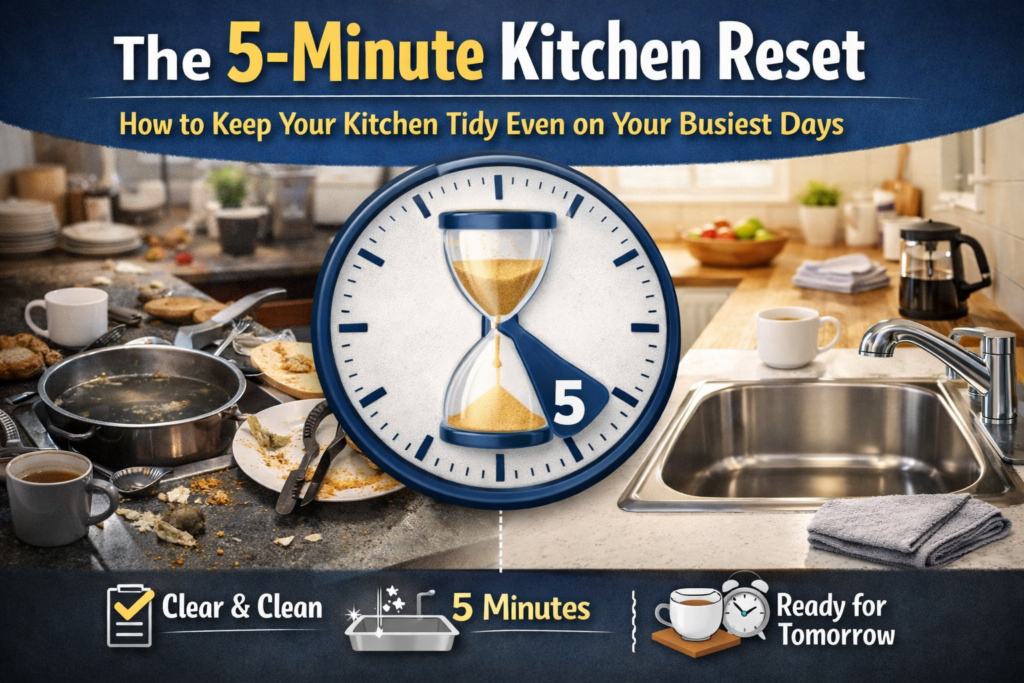
You just got home after a long, exhausting day. Your feet are tired, your mind is scattered, and the last thing you want to deal with is a messy kitchen. But there it is — dishes piled in the sink, counters covered in crumbs, and that one pot from last night still soaking in cold, gray water.
Sound familiar? You are not alone.
The truth is, most people do not struggle to clean their kitchen. They struggle to keep up with it. There is a big difference. Deep cleaning is something you do once in a while. But keeping your kitchen consistently tidy? That is a daily habit — and it does not have to take long.
Enter the 5-minute kitchen reset. It is a simple, repeatable routine that takes just a few focused minutes and transforms your kitchen from chaotic to calm. No big effort. No weekend marathons. Just a quick, intentional reset that makes your mornings easier, your evenings more peaceful, and your cooking more enjoyable every single day.
What Is a Kitchen Reset — And Why Does It Actually Work?
A kitchen reset is not a deep clean. Let that sink in for a second.
It is not scrubbing grout or reorganizing your pantry shelves. A reset is a short, focused sequence of small actions that return your kitchen to a ready state — clear counters, clean sink, nothing out of place. Think of it like hitting a restart button on your space.
The reason it works so well comes down to psychology. Research on cluttered environments consistently shows that visual disorder raises stress hormones and drains mental energy. When your kitchen looks chaotic, your brain reads it as a problem to solve — even when you are just trying to make breakfast.
A clean, reset kitchen does the opposite. It signals to your brain that the space is ready and in control. Psychologists call this the “fresh start effect,” and it is the same feeling you get from a blank notebook or a freshly made bed. Possibilities open up. Motivation follows.
And the beauty of five minutes? Your brain does not resist it. Five minutes feels manageable, easy, and non-threatening. That is exactly how habits form.
The Step-by-Step 5-Minute Kitchen Reset Routine
Here is a simple, minute-by-minute breakdown that you can follow every evening after dinner — or every morning before your day begins. Pick whichever timing fits your lifestyle best.
Minute 1 — Clear the Counters
Start with what the eye sees first. Visual clutter is what reads as “mess,” so your counters are always priority number one.
- Gather any items that do not belong in the kitchen — mail, keys, bags, chargers — and place them in a small tray or basket near the exit
- Put away ingredients left out from cooking
- Return any small appliances to their designated spots
Use a two-hand sweep technique: one hand lifts, the other moves. It cuts the time in half.
Pro Tip: Keep a small decorative tray on your counter as a “landing zone” for stray items. Instead of spreading clutter across your entire surface, everything lands in one spot. One grab, and it is gone.
Minute 2 — Handle the Dishes
A sink full of dirty dishes is the number one thing that makes a kitchen feel defeated. You do not have to wash everything right now — but you need to deal with it.
- Load the dishwasher with whatever has piled up through the day
- If you do not have a dishwasher, stack dishes neatly in the sink and fill it with hot, soapy water to soak overnight
- Rinse any dishes with stuck food immediately — the longer it sits, the harder it becomes to clean
Running the dishwasher overnight and emptying it each morning is one of the simplest daily habits you can build. You wake up to clean dishes, and the cycle starts fresh.
Minute 3 — Wipe Down Key Surfaces
This is not a deep scrub. It is a quick, refreshing wipe that removes crumbs, spills, and fingerprints from the surfaces you use most.
- Wipe countertops with a damp cloth or a light all-purpose spray
- Give the stovetop a quick pass — grease and spills are much easier to clean when they are fresh
- Wipe the outside of the microwave if needed
A homemade cleaning spray works beautifully here: mix equal parts water and white vinegar in a spray bottle. It cuts through grease, kills surface bacteria, and leaves your counters smelling clean without harsh chemicals.
Pro Tip: Keep your spray bottle and a folded microfiber cloth right on the counter or inside the cabinet closest to the stove. The easier it is to grab, the more likely you are to actually use it.
Minute 4 — Shine the Sink
There is something almost magical about a clean, empty, shining sink. It is the finishing touch that signals your kitchen is officially “closed” for the night.
- Rinse away any remaining food particles
- Give the sink a quick scrub with a brush and a little dish soap
- Dry it with a cloth if you have a stainless steel sink — it prevents water spots and keeps it looking polished
Cleaning professionals and home organization experts consistently point to the sink as the single most impactful visual focal point in any kitchen. A clean sink makes the whole room feel cleaner, even if nothing else changed.
Minute 5 — Stage for Tomorrow
This is the step most people skip — and it is the one that makes the biggest difference in your mornings.
Before you walk away, spend 60 seconds setting up tomorrow’s first task:
- Set out your coffee cup, kettle, or whatever you reach for first in the morning
- Place your cutting board on the counter if you prep breakfast
- Refill your water bottle and leave it somewhere visible
- Check that your bin bag is not full — if it is, swap it now so you are not doing it at 7am
This small act is essentially a gift to your future self. You wake up to a kitchen that is already prepared for you, and your morning starts with ease instead of friction.
How to Make the Reset a Habit That Actually Sticks
Knowing the routine is one thing. Doing it consistently is another. Here is how to make it automatic.
Attach it to an existing habit. The most powerful way to build any new routine is to “stack” it onto something you already do every day. After you finish eating dinner, you reset the kitchen. After you brush your teeth at night, you check the kitchen. The trigger needs to be specific and consistent.
Use a timer. Set a five-minute timer on your phone — or better yet, use a small sand timer on your counter. The timer creates a clear boundary. You work until it ends, and then you stop. This prevents “scope creep,” where a simple reset turns into a 40-minute reorganization project.
Add a micro-reward. Habits stick when they feel good. Light a candle that you only use during your kitchen reset. Play a short podcast or a song you love. Let the act itself feel like a pleasant ritual rather than a chore. Over time, your brain starts to associate the reset with a sense of calm and accomplishment.
Share the routine if you live with others. Assign micro-roles: one person handles the surfaces, another loads the dishwasher. When it is shared, it takes even less time and becomes a household rhythm rather than one person’s responsibility.
Morning vs. Evening Reset — Which One Should You Do?
Both have their benefits, and honestly, the best answer is whichever one you will actually do consistently.
The evening reset is the most popular choice, and for good reason. You clean up after the day’s cooking while the messes are still fresh. You wake up to a clear kitchen, which sets a calm, productive tone for your entire morning. Busy parents especially love this approach because it eliminates the chaotic morning scramble.
The morning reset works well if your evenings are unpredictable or you consistently come home exhausted. A quick morning sweep before the day starts means you always have a clean base to cook from, even if the evening got away from you.
The ideal routine? A light evening reset after dinner, plus a quick 60-second morning sweep when you unload the dishwasher. Together, they take less than 10 minutes total and keep your kitchen consistently clean throughout the entire week.
The Zones Method: Why Your Kitchen Stays Messy Without It
Even with a daily reset routine, some kitchens stay messy because nothing has a clear home. If you put something away and it does not have a designated spot, it ends up on the counter — again.
The solution is to organize your kitchen into functional zones based on how you actually cook and live.
- The cooking zone lives near the stove — cooking oils, spatulas, ladles, spices you use daily
- The prep zone sits near the counter or cutting board — knives, peelers, mixing bowls
- The storage zone is your pantry or cabinet — dry goods, canned items, snacks
- The drink zone holds your kettle, coffee supplies, mugs, and cups
- The cleaning zone sits near the sink — dish soap, sponges, cleaning spray, dish towels
When every item belongs to a zone, putting things away during your five-minute reset becomes effortless. You are not making decisions — you are just returning things to where they belong.
Pro Tip: Keep only the items you use most often on your countertops. Every appliance or tool that you use less than three times a week should live inside a cabinet. Clear counters are easier to wipe, faster to reset, and infinitely more calming to look at.
Common Reasons Kitchens Stay Messy (And the Simple Fix)
The problem: You clean but it always goes back to chaos within hours. The fix: Your organization system is not matching how you actually use the space. Reorganize based on real habits, not ideal habits.
The problem: Dishes pile up faster than you can wash them. The fix: Run the dishwasher every night, regardless of how full it is. An empty dishwasher cannot collect dishes.
The problem: The kitchen becomes a dumping ground for the whole house. The fix: Place a small basket near the kitchen exit specifically for non-kitchen items. Everything that does not belong gets dropped there, not on the counter.
The problem: You feel motivated for a week and then fall off completely. The fix: Lower the bar. On your worst days, just clear the counters and do the dishes. That is your minimum viable reset. Some effort is always better than none.
The Bigger Picture: What a Tidy Kitchen Does for Your Life
A consistently tidy kitchen is about much more than aesthetics.
When your kitchen is reset and ready, you cook more. Studies consistently link cluttered, stressful kitchen environments with poor food choices — people reach for takeout or processed food because the kitchen feels like too much work. A clean kitchen removes that barrier entirely.
You also waste less food. When your fridge and pantry are organized and visible, you actually see what you have. Items do not go forgotten at the back of a shelf. You use what you buy, which saves money every single week.
And perhaps most importantly, you start and end each day in a space that feels calm, intentional, and yours. A kitchen is the heart of any home. When it is in order, everything around it feels just a little bit more manageable too.
Final Thoughts
You do not need an hour. You do not need a Pinterest-perfect pantry or a drawer full of matching containers. You just need five minutes, a simple routine, and the consistency to show up for it — even on the days when you really do not feel like it.
The 5-minute kitchen reset is not about perfection. It is about momentum. It is about giving yourself a ready, welcoming space that makes cooking easier, mornings calmer, and daily life just a little bit lighter.
Start tonight. Set your timer. Clear your counters, do the dishes, wipe the surfaces, shine the sink, and stage your morning. Five minutes from now, your kitchen will thank you — and so will tomorrow’s version of you.
Leave a Reply