
Let’s be honest — a disorganized kitchen doesn’t just look messy. It makes cooking slower, more frustrating, and way less enjoyable. You can’t find the right lid, your spices are buried behind three other things, and every meal prep session starts with a minor excavation project. Sound familiar?
Here’s the truth: a genuinely organized kitchen isn’t about having a Pinterest-perfect space or spending a fortune on a full renovation. It’s about smart systems, the right tools, and a few clever habits that make your kitchen work for you instead of against you.
Kitchen organization hacks have taken TikTok by storm, with creators sharing everything from minimalist glass jars to store pasta and spices, to efficient methods to utilize small cupboard spaces — and home cooks everywhere are seeing real results. Shiny Egypt Tours
In this guide, you’ll find the most effective, practical, and affordable kitchen organization strategies you can start using today — whether you have a sprawling open kitchen or a tiny apartment galley. Let’s transform your kitchen, one zone at a time.
Why Kitchen Organization Is Worth Your Time and Energy
Before we dive into the hacks, let’s talk about why this matters beyond just aesthetics. An organized kitchen genuinely changes the way you cook and eat.
When your kitchen is organized, meal prep becomes faster because everything is exactly where you expect it. You waste less food because you can actually see what you have. You cook more often because the process is enjoyable instead of stressful. You save money because you stop buying duplicates of things that were hiding in the back of a cluttered cabinet.
An organized kitchen makes everything feel fresh, tidy, and accessible — and that feeling directly motivates you to cook more, waste less, and enjoy your kitchen as the heart of your home that it’s meant to be. Koshari Shack
The goal isn’t perfection. The goal is a kitchen that works smoothly, looks calm, and makes you actually want to spend time in it.
The Golden Rule of Kitchen Organization: Zone Everything
The single most powerful shift you can make in your kitchen is to stop thinking about it as one large space and start thinking about it as a collection of dedicated zones. Every professional kitchen — from Michelin-starred restaurants to catering operations — is built around this principle, and it works just as brilliantly at home.
Here are the core zones every kitchen should have:
The Prep Zone — Your primary cutting and chopping area. Keep your knives, cutting boards, peelers, graters, and measuring tools here. Everything you reach for during active prep should live in this zone.
The Cooking Zone — The area around your stove and oven. Store pots, pans, cooking utensils, oils, and your most-used spices here. Anything you need while something is on the heat should be within arm’s reach.
The Storage Zone — Your pantry, cabinets, and dry goods area. This is where grains, canned goods, pasta, and baking supplies live — organized by category and easy to scan at a glance.
The Cleaning Zone — Your sink area. Dish soap, scrubbers, drying rack, and cleaning supplies belong here and nowhere else.
The Serving Zone — Where plates, bowls, glasses, and cutlery are stored. Ideally close to the dining area so setting the table takes seconds.
Pro Tip: Once you’ve defined your zones, commit to them. The biggest enemy of kitchen organization isn’t clutter — it’s items that drift into the wrong zone and never make it back.
Cabinet and Drawer Organization: Conquering the Chaos Inside
Cabinets and drawers are where kitchen organization dreams go to die — unless you have a smart system. Here’s how to take control of every inch.
Sort Everything by Frequency of Use
Make sure what you use most is the easiest to access. This goes for glassware and pans as well as food. Place your most-used glasses on the bottom shelves since you’ll be reaching for them often — no need to make more trouble by shuffling glasses you rarely use out of the way every time you want something. Country and Town House
The same logic applies to everything else in your kitchen. Your everyday dinner plates? Eye level and front of cabinet. The decorative serving platter you use twice a year? High shelf, back corner. Your daily coffee mug? Bottom shelf, first in line.
Use Adhesive Bins Inside Cabinet Doors
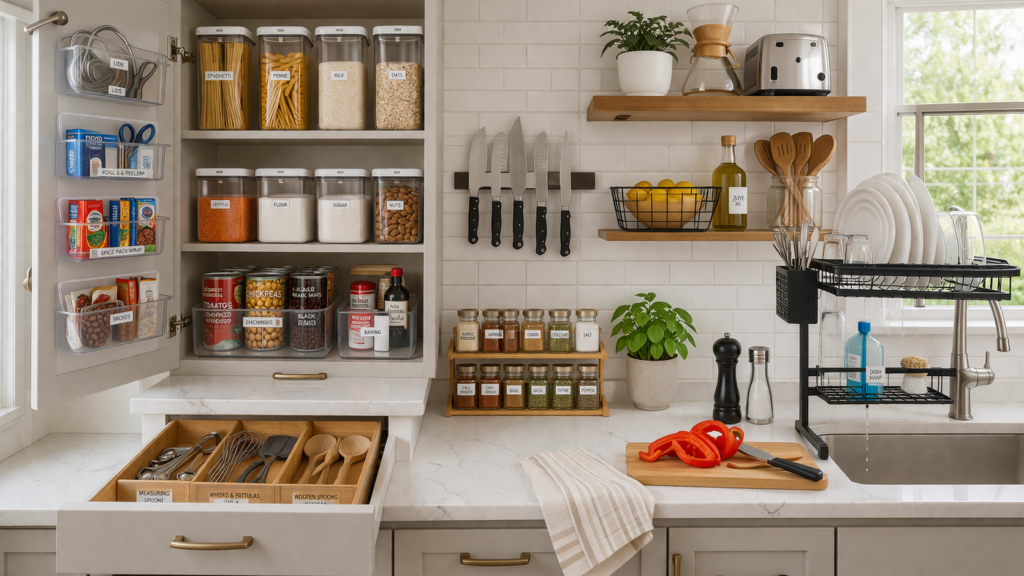
This is one of the most underrated storage moves in the kitchen. Adhesive bins that attach to the inside of cabinet doors are perfect for small lids, kitchen supplies like shears and peelers, or food items — and they help you keep track of all the little things that can float around the kitchen. Country and Town House
The inside of a cabinet door is essentially free storage space that most people completely ignore. Use it for spice packets, small lids, foil and cling film boxes, or cleaning tools under the sink.
Tame the Drawer Chaos With Dividers
Every kitchen has that one drawer — you know the one. It’s a graveyard of random utensils, mystery gadgets, and every takeaway menu from 2019. It’s time to deal with it.
Drawer dividers are inexpensive, adjustable, and absolutely transformative. Sort your utensils into logical groups: measuring spoons together, wooden spoons together, whisks and spatulas together. Once everything has a designated slot, the drawer stays organized naturally because there’s a clear “right place” for everything.
Pro Tip: If bins don’t work for your utensil drawer, consider small command hooks to hold measuring cups and spoons instead. There’s no reason to rifle through a chaotic drawer or try to wrangle measuring tools back onto a plastic keychain every time you use one. Country and Town House
The Pot and Pan Problem — Solved
Pots and pans are bulky, awkward, and notoriously difficult to store neatly. Here are three approaches that actually work:
Pan organizer racks — vertical dividers that let you store pans upright instead of stacking. Pull out the one you need without disturbing the others.
Pot lid organizers — dedicated racks that hold lids vertically. Lids are the number one cause of cabinet chaos; give them their own home.
Deep lower cabinet pull-outs — if you’re open to a small investment, pull-out shelves for lower cabinets are one of the highest-ROI kitchen upgrades you can make. No more kneeling on the floor and removing five things to reach the one you want.
Pantry Organization: The System That Changes Everything
A well-organized pantry is the beating heart of a functional kitchen. When your dry goods are organized clearly, you always know what you have, you never accidentally buy three bags of the same pasta, and meal planning becomes a genuinely enjoyable activity instead of a guessing game.
The Clear Container Method
Minimalist glass jars and clear containers to store pasta, spices, and grains are one of the most viral and enduring kitchen organization trends — and they work because they make everything visible at a glance. Shiny Egypt Tours
Transfer your dry goods — rice, pasta, lentils, oats, sugar, flour, nuts — into matching clear containers. Label each one. The visual uniformity immediately makes your pantry look calmer and more intentional, and the practical benefit is even better: you can see exactly what you have and how much is left without opening anything.
Airtight containers also keep dry goods significantly fresher for longer, which means less food waste and better-tasting ingredients.
Label Everything With Expiration Dates
If you place dry or perishable food in reusable containers, be sure to label expiration dates. Using a dry-erase marker makes it easier to know when to cycle out old food without needing to hold onto all the packaging. This also works brilliantly for fridges and deep freezers — and if your container surface isn’t already dry-erase marker friendly, apply dry-erase contact paper. Country and Town House
This single habit alone can cut your food waste dramatically. No more mystery containers, no more sniffing something to determine if it’s still good, no more throwing out a full container of expensive spice because you forgot when you opened it.
Organize Pantry Items by Category — Then by Frequency
Group your pantry items into clear categories: grains and pasta together, canned goods together, baking supplies together, snacks together, spices together. Within each category, put what you use most at the front.
A well-organized pantry with ingredients perfectly categorized and right at your fingertips is genuinely life-changing — it makes meal planning faster, grocery shopping smarter, and cooking more intuitive every single day. Koshari Shack
Fridge Organization: Stop Losing Food in the Back
The fridge is where good intentions go to expire. Here’s how to keep it organized so nothing gets lost and nothing goes to waste.
Use Clear Stackable Bins
Clear stackable bins inside the fridge are perfect for creating organized zones — pair them with good labeling for even more control over your space. Country and Town House Dedicate one bin to snacks, one to meal-prepped items, one to dairy products. When you open the fridge, you scan zones instead of hunting through a jumble.
The First In, First Out Rule
This is the same system professional kitchens use to manage food safely and reduce waste. When you bring home new groceries, move older items to the front and put the new ones behind them. You’ll always use what needs to be eaten first without having to consciously track anything.
Dedicated Zones for the Fridge Too
Apply the same zone logic to your fridge as your kitchen:
- Top shelf — ready-to-eat foods, leftovers, drinks
- Middle shelf — dairy, eggs, prepared foods
- Lower shelf — raw proteins (always on the bottom to prevent cross-contamination drips)
- Crisper drawers — one for fruits, one for vegetables; keep them separate as many fruits release ethylene gas that accelerates vegetable spoilage
- Door shelves — condiments, sauces, butter; the door is the warmest part of the fridge so never store milk or eggs there
Counter Organization: The Art of Visible Calm
Your kitchen counters set the visual tone for your entire kitchen. Cluttered counters make even a beautiful kitchen feel chaotic and stressful. Clear, intentional counters make even a modest kitchen feel spacious and serene.
The Rule of Intentional Counter Items
Only two categories of items should permanently live on your counter: things you use every single day and items that are too large to store elsewhere conveniently. For most kitchens, this means: the kettle or coffee maker, the toaster, a fruit bowl, and possibly a small knife block.
Everything else — the bread maker you use monthly, the blender you use weekly, the decorative items collecting dust — should be stored away. Retrieve them when needed and put them back after.
Use Vertical Space Aggressively
Counter space is precious. Vertical space — the walls and areas above the counter — is almost always underutilized. Magnetic knife strips mounted on the wall free up an entire knife block from your counter. Floating shelves above the counter create storage without taking up working surface. Stackable risers inside cabinets double your shelf space without any installation.
Smart space-saving solutions — especially those that use vertical or over-door storage — are among the most viral and widely saved kitchen organization ideas right now because they solve the most common problem in real kitchens: not enough space. Asperogroup
Over-the-Sink Drying Rack
If counter space around your sink is constantly eaten up by drying dishes, this one upgrade solves the problem elegantly. Over-the-sink drying racks are viral organization solutions, especially for small kitchens — they help make more counter space available while drying dishes efficiently, and appear regularly in top kitchen hacks content. Asperogroup
The dishes dry over the sink, water drips directly into the drain, and your counter remains clear and ready for cooking. Simple, functional, brilliant.
Spice Organization: Find What You Need in 3 Seconds
Spices are notoriously difficult to organize — they’re small, they look similar, and they have a habit of multiplying. Here are the best systems:
Drawer spice organizer — lay spices flat in a designated drawer with labels on the lids facing up. Open the drawer and see every spice at a glance. Incredibly efficient.
Tiered shelf riser inside the cabinet — creates two rows of spice jars visible from the front without reaching to the back.
Pull-out spice rack on the cabinet door — a narrow rack mounted inside a cabinet door holds 20+ spice jars with everything visible and accessible immediately.
Matching labeled jars — transfer spices from mismatched packaging into uniform small jars with clear labels. The visual uniformity alone makes your spice collection significantly easier to navigate — and it looks absolutely beautiful.
Pro Tip: Store spices away from heat and direct sunlight. The cabinet next to or above your stove seems logical but it’s actually the worst place for spices — the heat and steam degrade them rapidly. A cabinet on the opposite wall keeps them fresher for much longer.
Small Kitchen? These Hacks Are Specifically for You
Small kitchen? No problem. Some of the most beautifully organized kitchens in the world are tiny — because constraint forces creativity.
Mount a pegboard — a pegboard on an empty wall becomes a fully customizable storage system for pots, pans, utensils, and small tools. It keeps everything visible and accessible while taking up zero cabinet or counter space.
Use the space above the fridge — often completely ignored, the top of the refrigerator is perfect for infrequently used items: large serving bowls, seasonal items, extra pantry overflow.
Tension rods inside cabinets — vertical tension rods installed in a lower cabinet create perfect slots for storing baking sheets, cutting boards, and pan lids upright. Cheap, tool-free, and staggeringly effective.
Hooks everywhere — inside cabinet doors, on the sides of cabinets, under shelves. Hooks hold mugs, utensils, measuring cups, pot holders, and more. Each hook you install creates storage without taking up any existing space.
Stackable clear bins in the fridge — clear stackable bins are perfect for creating more usable space in the fridge, allowing you to stack items efficiently while keeping everything visible and separated by category. Country and Town House
Building Habits That Keep Your Kitchen Organized Long-Term
Organization systems are only as good as the habits that maintain them. Here’s how to make sure your kitchen stays organized after the initial effort:
The one-minute rule — if something takes less than a minute to put away or wipe down, do it immediately rather than leaving it for later. This single habit prevents 90% of kitchen clutter from accumulating.
The “everything has a home” rule — if an item doesn’t have a clear, designated home in your kitchen, it will always drift around and create clutter. Every single item in your kitchen should have one specific place where it belongs.
The daily reset — spend 5 minutes at the end of each evening returning everything to its place, wiping down counters, and resetting the kitchen for the next morning. Walking into a tidy kitchen the next day genuinely changes your mood and motivates better cooking.
The monthly audit — once a month, take 15 minutes to scan your pantry and fridge for anything approaching expiration, anything that has drifted out of its zone, or anything that needs restocking. This keeps your system current and functional rather than gradually sliding back into chaos.
The Best Affordable Products to Elevate Your Kitchen Organization
You don’t need to spend a fortune. These high-impact, budget-friendly products appear over and over in the most viral kitchen organization content for good reason — they genuinely work:
- Clear airtight containers — for pantry staples; uniform and stackable
- Bamboo drawer dividers — adjustable, sustainable, and instantly tidying
- Lazy Susan turntable — for corner cabinets, spice shelves, and fridge shelves; eliminates the “stuff lost in the back” problem completely
- Stackable wire shelves — double the usable space on any cabinet shelf
- Pull-out cabinet organizers — self-adhesive, no tools required, instant accessibility upgrade
- Magnetic spice jars — mount on the fridge side for a beautiful, accessible spice display
- Over-the-door organizers — instant storage on the back of any cabinet door or pantry door
- Label maker or chalk labels — the finishing touch that makes any organized kitchen look truly intentional
Final Thoughts: Your Kitchen, Transformed
A truly organized kitchen doesn’t happen overnight — and it doesn’t require a renovation budget, a personal organizer, or a perfectly designed space. It requires a clear system, a commitment to zones, the right storage tools, and the daily habits that keep everything in its place.
Start with one area this week. Maybe it’s that chaotic junk drawer, or the spice cabinet you’ve been avoiding, or the counter that’s slowly disappearing under clutter. Tackle one zone, get it right, and let the momentum carry you to the next.
An organized kitchen makes you happy — and that feeling of calm, tidy, accessible space directly motivates you to cook more, waste less, and truly enjoy your kitchen every single day. Koshari Shack
Because at the end of the day, the kitchen isn’t just a room in your house. It’s where meals are made, where flavors are discovered, and where so many of life’s best moments actually happen. It deserves to work as beautifully as you do.
Leave a Reply