
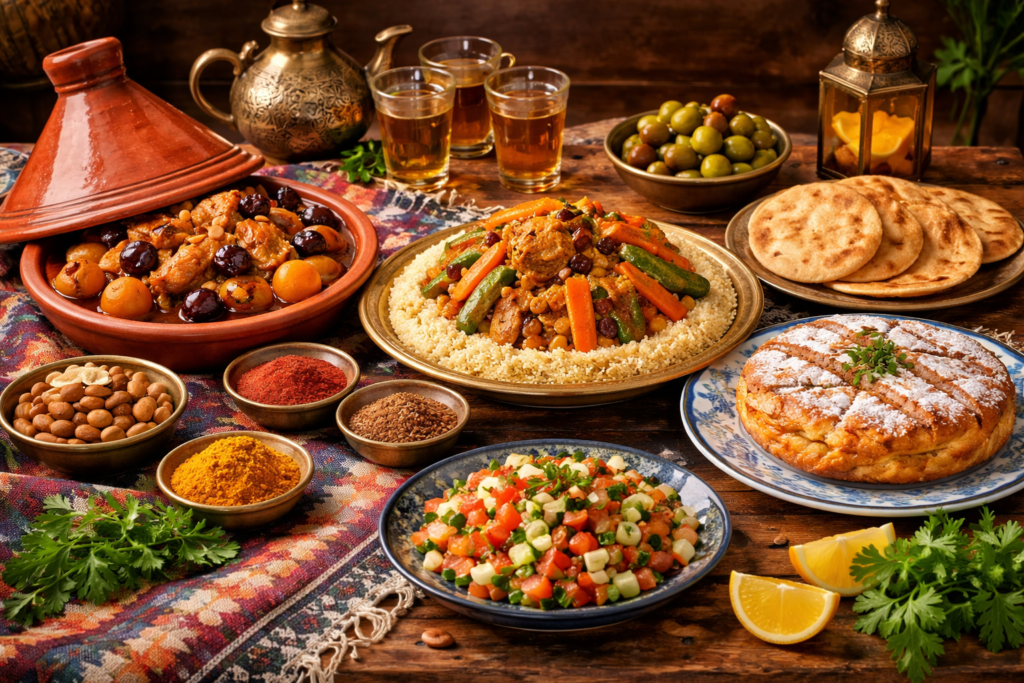
There are cuisines that feed you, and there are cuisines that transport you. Moroccan food belongs firmly in the second category.
From the moment a tagine lid is lifted at the table — releasing a cloud of steam carrying the scent of cumin, cinnamon, preserved lemon, and slow-cooked lamb — you understand that Moroccan cuisine is something altogether different. It is food built on patience, layered spicing, and an almost artistic attention to balance. Sweet and savory coexist naturally. Warm spices meet fresh herbs. Rich, slow-cooked proteins sit alongside bright, acid-kissed salads.
Moroccan cuisine has attracted global admiration for good reason. It is one of the most complex and historically rich food cultures on earth, shaped by Berber, Arab, Andalusian, and Mediterranean influences over more than a thousand years. The result is a culinary tradition that feels both ancient and endlessly relevant.
Whether you’re discovering Moroccan food for the first time or looking to deepen your understanding of a cuisine you already love, this complete guide covers everything — the essential dishes, the foundational spices, the cooking techniques, the street food culture, and the traditions that hold it all together.
The History Behind the Flavors
To understand Moroccan cuisine, it helps to understand where it came from.
Morocco sits at a crossroads. Geographically, it bridges Africa, the Arab world, and the Mediterranean. Historically, it served as a meeting point for trade routes that carried spices, ingredients, and culinary ideas from as far away as Persia, sub-Saharan Africa, and medieval Andalusia.
The Berbers — Morocco’s indigenous people — laid the original culinary foundation. Their contributions include slow cooking over open fire, the use of preserved and fermented ingredients, and foundational dishes like couscous and pastilla. When Arab and Moorish influences arrived, they brought new spice traditions and sophisticated flavor-layering techniques. Later, the influx of Andalusian refugees from Spain introduced new vegetables, herbs, and cooking refinements that further enriched the cuisine.
The result of all this exchange is a food culture that feels generous, layered, and unmistakably its own.
The Spice Philosophy of Moroccan Cooking
If there is one thing that defines Moroccan cuisine above all others, it is the relationship with spice. But this isn’t heat-driven spicing. Moroccan cooking is not primarily about chili fire — it is about aromatic depth, warmth, and complexity.
Ras el Hanout
This is the crown jewel of Moroccan spice blends. The name translates loosely to “head of the shop,” implying the best of what a spice merchant has to offer. A traditional ras el hanout can contain anywhere from 12 to 30 individual spices, including cumin, coriander, cinnamon, ginger, cardamom, turmeric, nutmeg, black pepper, and rose petals.
No two blends are exactly alike. Families and spice merchants have their own closely guarded versions. It is used in tagines, couscous dishes, marinades, and slow-braised meats.
Cumin
Used both ground and whole, cumin is among the most frequently used spices in Moroccan cooking. It appears in spice rubs, salads, soups, and street food seasonings.
Paprika and Cayenne
Sweet paprika provides color and mild depth. A touch of cayenne adds just enough warmth without overwhelming the palate.
Turmeric
Used for its golden color and mild earthiness, turmeric appears in many Moroccan chicken and vegetable dishes.
Cinnamon
One of the more surprising elements to those new to Moroccan food, cinnamon is used confidently in savory dishes — particularly in tagines with lamb or beef and in the pastilla, where its warm sweetness plays beautifully against the richness of the filling.
Preserved Lemons
Technically a condiment rather than a spice, preserved lemons are indispensable to Moroccan cooking. The long preservation process transforms fresh lemons into something intensely flavorful — less sharp, more rounded, and deeply savory. They appear in tagines, salads, and grilled fish dishes throughout the country.
Harissa
A fiery chili paste with roots across North Africa, harissa is used in Moroccan cooking both as an ingredient and a condiment. Made from roasted red chilies, garlic, olive oil, and spices, it adds heat and complexity wherever it goes.
Essential Moroccan Dishes You Must Know
Tagine — The Heart of Moroccan Cooking
The tagine is both a cooking vessel and a category of dish. The distinctive conical clay pot creates a self-basting environment during cooking — steam rises, condenses on the cone, and falls back into the pot, keeping the contents moist and intensely flavorful throughout the long, slow cooking process.
Lamb Tagine with Prunes and Almonds One of the most celebrated Moroccan tagines, this dish embodies the sweet-savory balance that defines the cuisine. Slow-cooked lamb shoulder becomes fork-tender in a sauce deepened with warming spices, then finished with sweet dried prunes and toasted almonds. Served with fresh bread for scooping, it is deeply satisfying and surprisingly elegant.
Chicken Tagine with Preserved Lemon and Olives This is perhaps the most internationally recognized Moroccan dish. Chicken pieces are braised slowly with onions, garlic, turmeric, ginger, and saffron. Preserved lemon and briny olives are added toward the end, giving the sauce a bright, complex finish that is entirely unlike anything else in world cooking.
Vegetable Tagine A completely plant-based tagine packed with root vegetables, chickpeas, butternut squash, and tomatoes, slow-cooked with ras el hanout and finished with a scattering of fresh herbs. Rich, filling, and deeply spiced — proof that meat is never a requirement for an exceptional Moroccan meal.
Couscous — Morocco’s National Dish
Ask any Moroccan what the national dish is, and the answer is unanimous: couscous. Specifically, the version served on Fridays — a centuries-old tradition that brings families together after midday prayers.
Traditional Moroccan couscous is not the quick-cook variety familiar from supermarket boxes. It is hand-rolled semolina, steamed multiple times in a couscoussier (a specialized double-pot steamer) until each grain is light, separate, and perfectly fluffy. The couscous is then mounded on a large communal platter and topped with a rich broth and tender pieces of chicken, lamb, or beef, surrounded by slow-cooked vegetables — carrots, turnips, zucchini, onions, and chickpeas.
The entire dish is a labor of love, and sharing it from a common plate is a deeply meaningful ritual in Moroccan family culture.
Pastilla — Sweet, Savory, and Extraordinary
Few dishes in world cuisine are as genuinely surprising as Moroccan pastilla. On the surface, it appears to be a pie — thin, crispy layers of warqa pastry filled with a savory mixture of slow-cooked pigeon or chicken, eggs, and almonds, then dusted with powdered sugar and cinnamon on top.
That combination sounds unusual. It tastes extraordinary.
Pastilla is traditionally served at celebrations and gatherings, and it represents one of the finest examples of the Andalusian influence on Moroccan cooking — the sophisticated interplay of sweet and savory in a single, unified dish.
Harira — Morocco’s Beloved Soup
Harira is more than just a soup. It is a cultural institution. This thick, warming bowl of tomatoes, lentils, chickpeas, fresh herbs, and a whisper of spice has nourished Moroccan families for generations.
It is typically enjoyed in the late afternoon or evening, served with soft bread, dates, and honey-drenched chebakia cookies. The texture is somewhere between a soup and a light stew — hearty enough to satisfy, delicate enough to want a second bowl.
Harira freezes beautifully and tastes even better the next day, making it one of the most practical dishes in the Moroccan repertoire.
Zaalouk — Smoky Eggplant Salad
Moroccan cuisine features a remarkable collection of cooked vegetable salads served at the start of a meal, and zaalouk is among the finest. Roasted or grilled eggplant is combined with tomatoes, garlic, olive oil, cumin, paprika, and fresh cilantro and parsley, then cooked down into a silky, spreadable salad that is served warm or at room temperature.
It is smoky, rich, faintly sweet, and completely addictive. Eaten with warm khobz bread, it is one of the great simple pleasures of Moroccan food.
Mechoui — The Art of Slow-Roasted Lamb
Mechoui is whole lamb slow-roasted over coals or in a pit, basted regularly with spiced butter, until the meat falls from the bone and the skin turns golden and crisp. It is one of the most festive preparations in Moroccan cooking — a centerpiece dish for large gatherings and celebrations, carved tableside and eaten with cumin and salt for dipping.
The technique is simple. The result is extraordinary.
Moroccan Street Food Culture
Walk through the medina of any Moroccan city and the street food scene unfolds around you — smoke rising from grills, the smell of spiced meat, vendors calling out from their stalls.
Kefta Skewers — Seasoned ground lamb or beef mixed with onion, parsley, cumin, and paprika, formed around skewers and grilled over charcoal. Served with flatbread and a scatter of fresh herbs, they are one of Morocco’s most satisfying street foods.
Msemen — Flaky, square-shaped flatbreads cooked on a griddle until crispy on the outside and layered within. Eaten plain with honey, or stuffed with kefta and vegetables, they are a morning staple at markets and breakfast spots across the country.
Bissara — A humble but deeply nourishing soup made from dried split fava beans pureed with olive oil, cumin, and paprika. A bowl costs almost nothing and warms you from the inside out. It is beloved as a working-class morning meal in northern Morocco.
Sfenj — Moroccan doughnuts, made from a soft yeasted dough fried in hot oil until golden and puffed. Sold on strings by street vendors, they are dusted in sugar and eaten warm. Irresistible.
The Role of Bread in Moroccan Food Culture
Bread is not a side item in Moroccan cuisine — it is a utensil, a ritual, and a statement of hospitality.
Khobz, the round, slightly dense everyday loaf, is present at every Moroccan table. Meals are often eaten communally from a shared plate, and khobz is the tool with which you scoop, dip, and gather. To tear bread with someone in Morocco is an act of welcome.
Bread is baked fresh daily — traditionally in communal neighborhood ovens called farrans, where families would bring their shaped dough in the morning and collect it baked before lunch.
Mint Tea — The Drink That Defines Moroccan Hospitality
No guide to Moroccan cuisine is complete without addressing mint tea. Poured from a silver teapot held high above small glasses to create a light foam on top, Moroccan mint tea is as much a ceremony as it is a drink.
Made with Chinese gunpowder green tea, fresh spearmint, and generous amounts of sugar, it is served three times in the tradition — each glass representing, as the saying goes, “life, love, and death.” To refuse mint tea in a Moroccan home is to decline hospitality itself.
Tips for Cooking Moroccan Food at Home
Moroccan cuisine is more approachable at home than many people assume. A few guiding principles will take you far:
Invest in a tagine or Dutch oven. A clay tagine is ideal, but a heavy Dutch oven works beautifully for slow-cooked dishes. The key is low heat and a tight seal.
Build your spice collection gradually. You don’t need everything at once. Start with cumin, coriander, cinnamon, turmeric, and paprika. Add ras el hanout and preserved lemons, and you can make the majority of classic Moroccan dishes.
Don’t rush the cooking process. Moroccan food rewards patience. A tagine cooked for two hours is infinitely better than one cooked for forty-five minutes.
Use fresh herbs generously. Cilantro and flat-leaf parsley are used in abundance — as ingredients during cooking and as finishing garnishes. Don’t be shy with them.
Taste and adjust as you go. Moroccan cooking is intuitive and personal. Salt, a squeeze of lemon, an extra pinch of cumin — small adjustments at the end can bring a dish from good to exceptional.
Final Thoughts
Moroccan cuisine is a world unto itself. It is ancient without feeling dated, complex without being intimidating, and generous in a way that few food cultures manage to replicate. Every dish carries a story — of trade routes and family kitchens, of spice merchants and communal ovens, of hospitality extended through a teapot held high.
Whether you begin with a simple zaalouk served with warm bread, or commit to a full Friday couscous spread, you are stepping into one of the great culinary traditions on earth.
And once you do, it is very difficult to step back out.
FAQ Section
Q: What makes Moroccan cuisine unique compared to other North African cuisines? A: Moroccan cuisine stands out for its extraordinary spice layering, the prominent use of sweet-savory combinations, and its Andalusian influences — elements not found as strongly in neighboring Algerian or Tunisian cooking. The use of ingredients like preserved lemons, argan oil, and ras el hanout gives Moroccan food a flavor profile that is distinctly its own.
Q: Is Moroccan food spicy in terms of heat? A: Not predominantly. Moroccan cuisine is deeply spiced — meaning aromatic and complex — but it is not typically fiery hot. Warmth comes from ginger, cinnamon, and black pepper rather than chili. Harissa is used as a condiment for those who want added heat, but the base dishes are generally mild enough for the whole family.
Q: What is the difference between a tagine and a stew? A: A tagine is cooked in a specialized conical clay vessel that creates a self-basting environment through steam circulation. This slow, gentle cooking method produces more tender meat, more deeply developed flavors, and a more concentrated sauce than a conventional stew cooked in an open pot. The clay vessel also imparts a subtle earthiness to the dish over time.
Q: Can I make Moroccan recipes without a tagine pot? A: Absolutely. A heavy-bottomed Dutch oven or deep casserole dish with a tight-fitting lid works very well as a substitute. The key is maintaining low, even heat and keeping the lid on during cooking to replicate the steam-circulation effect of the traditional clay tagine.
Q: What do Moroccans typically eat for breakfast? A: A traditional Moroccan breakfast is a wonderfully varied spread. It typically includes msemen or rghaif (flaky flatbreads), khobz with butter and honey, olive oil, amlou (a rich almond and argan oil paste), fresh-squeezed orange juice, and mint tea or coffee. Hard-boiled eggs and soft cheese often appear alongside.
Q: What is argan oil and how is it used in Moroccan cooking? A: Argan oil is produced from the kernels of the argan tree, which grows almost exclusively in the Souss region of Morocco. Culinary argan oil — roasted and pressed — has a warm, nutty flavor and is used to dress salads, dip bread, and make amlou. It is distinct from cosmetic-grade argan oil and is considered one of the world’s most prized and healthful cooking oils.
Call to Action
Inspired to bring Moroccan flavors into your own kitchen? Start with something simple — a batch of zaalouk, a chicken tagine, or a pot of harira — and let the aromas do the convincing. Moroccan cooking rewards curiosity, and every dish you try will open a door to another.
💬 Have you tried cooking Moroccan food at home? What’s your favorite dish or spice to work with? Share your experience in the comments — we’d love to hear from you!
📌 Save this guide for your next cooking adventure and share it with anyone who loves discovering the world through food.
Leave a Reply