
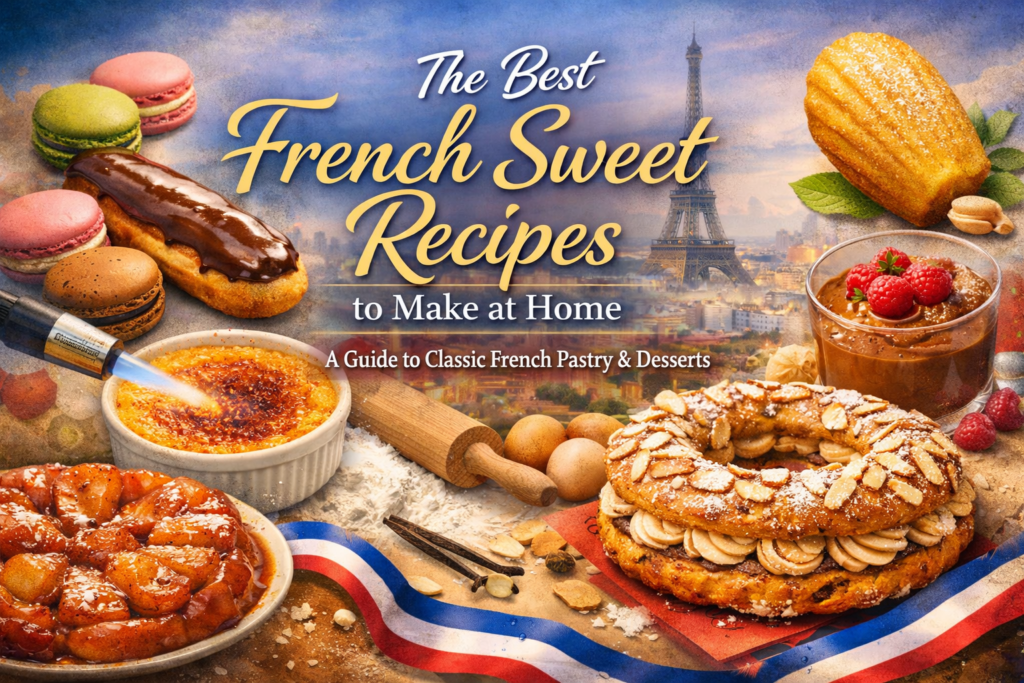
There is a reason French pastry has dominated the world of desserts for centuries. Walk into any great bakery in Paris — past the gleaming display cases lined with perfect rows of jewel-colored macarons, flawlessly glazed éclairs, and caramelized tarte Tatins still warm from the oven — and you understand immediately why French sweets occupy a category entirely their own.
But here is what most people don’t realize: the most iconic French desserts are not nearly as intimidating as they look. While French patisserie is a unique science that requires precision and an understanding of both ingredients and the baking environment, getting it right feels like a genuine achievement — and when you do, the results are spectacular Spatula Desserts.
In 2026, interest in French baking techniques, laminated dough tutorials, and classic pastry recipes continues climbing sharply, with consumers driven by a deep desire for indulgence, comfort, craftsmanship, and sensory novelty Tastewise. People want to bring the magic of a Parisian pâtisserie into their own kitchens — and with the right guidance, they absolutely can.
This guide covers the best classic French sweet recipes you can make at home — from the legendary crème brûlée to the delicate madeleine, from the showstopping chocolate mousse to the rustic, irresistible tarte Tatin. Each recipe comes with clear instructions, professional tips, and everything you need to make French desserts with real confidence.
Before You Begin: The Secrets of French Pastry Success
French baking rewards preparation and precision. Before diving into the recipes, here are the principles that separate good French desserts from truly great ones:
Use the best butter you can find. French pastry chefs insist on high-fat European-style butter with at least 82% fat content — the higher fat and lower water content makes a measurable difference in both flavor and texture for every recipe from croissants to madeleines Spatula Desserts. This single upgrade will transform your results more than any technique.
Weigh your ingredients. French patisserie uses weight measurements, not volume. A kitchen scale is not optional — it is essential. Baking is chemistry, and precise measurements are the difference between a soufflé that soars and one that deflates.
Respect temperature. Butter that is too warm ruins pastry dough. Egg whites that are not at room temperature won’t whip properly for macarons. Oven temperature is critical — use an oven thermometer to ensure your stated temperature matches reality.
Read the full recipe before starting. Many French desserts have multiple components, some of which need to rest, chill, or set. Understanding the timeline before you begin saves frustration and produces far better results.
With those principles in place, let’s get into the recipes.
1. Crème Brûlée — The Quintessential French Dessert
If there is one French dessert that has captured the imagination of the entire world, it is crème brûlée. The dramatic moment of shattering that perfectly caramelized sugar crust with the back of a spoon to reveal the silky, trembling vanilla custard beneath is one of the most satisfying experiences in all of cooking.
And the beautiful secret? It is genuinely straightforward to make.
Ingredients (serves 4):
- 500ml heavy cream
- 1 vanilla bean (or 1 tsp pure vanilla extract)
- 5 large egg yolks
- 100g caster sugar, plus extra for the topping
How to make it: Preheat your oven to 160°C (325°F). Split the vanilla bean lengthways and scrape out the seeds. Heat the cream with the vanilla seeds and pod in a saucepan over medium heat until just beginning to steam — do not boil. Remove from the heat and let the vanilla infuse for 10 minutes. Meanwhile, whisk the egg yolks with 100g of caster sugar until pale and slightly thickened. Remove the vanilla pod from the cream and pour it slowly over the egg yolk mixture, whisking constantly and gently to combine without creating foam. Strain through a fine sieve into a jug.
Place four ceramic ramekins in a deep roasting tray. Pour the custard mixture evenly into the ramekins. Carefully pour boiling water into the roasting tray to reach halfway up the sides of the ramekins. Bake for 30–35 minutes until the custard is set with just the faintest wobble in the centre. Remove from the water bath and cool to room temperature, then refrigerate for at least 4 hours, ideally overnight.
When ready to serve, sprinkle an even, thin layer of caster sugar over each custard. Using a kitchen blowtorch, caramelize the sugar in slow, circular motions until it turns deep amber and forms a perfectly glassy crust. Serve immediately.
Pro tip: The water bath (bain-marie) is non-negotiable — it surrounds the custard with gentle, even heat that prevents the eggs from curdling and creates that signature silky texture. Rushing this step always shows in the result.
What makes it French: Crème brûlée is the ultimate expression of French dessert philosophy — just a handful of the finest ingredients, treated with absolute care and precision, transformed into something that feels truly luxurious.
2. French Macarons — The Icon of Parisian Patisserie
Few desserts are more recognizable or more deeply associated with French baking than the macaron. Those delicate, jewel-colored almond meringue shells sandwiched with ganache, buttercream, or jam are both a technical achievement and an edible work of art.
French macarons are made with egg whites and almond flour — a deceptively simple ingredient list that requires precision at every step, but rewards the effort with a dessert that is genuinely unlike anything else in the world of baking Kellystilwell.
Ingredients (makes approximately 20 sandwich cookies):
- 125g almond flour, finely ground
- 200g icing sugar
- 100g aged egg whites (separated 24–48 hours ahead)
- 35g caster sugar
- Pinch of cream of tartar
- Gel food coloring of your choice
- For the filling: 100g dark chocolate + 80ml heavy cream (ganache)
How to make it: Sift the almond flour and icing sugar together three times — this step is essential for smooth, lump-free shells. Set aside. In a perfectly clean bowl, whisk the egg whites with the cream of tartar until foamy, then gradually add the caster sugar while whisking until you reach stiff, glossy peaks. Add your chosen gel coloring and fold it in gently.
Now comes the most critical technique: macaronage. Using a wide spatula, fold the almond flour mixture into the meringue in a figure-eight motion, pressing the batter against the sides of the bowl as you go. Continue until the batter falls from the spatula in a thick, slow ribbon that disappears back into the bowl within about 10 seconds. This is the “lava” consistency that produces perfect shells.
Transfer to a piping bag fitted with a round nozzle. Pipe 3.5cm rounds onto baking trays lined with parchment paper, spacing them 2cm apart. Bang the trays firmly on the counter several times to release air bubbles. Let the piped shells rest at room temperature for 30–60 minutes until they form a dry, non-sticky skin. Bake at 150°C (300°F) for 14–16 minutes. Cool completely before filling.
For the ganache filling, bring the cream to a gentle simmer, pour over the chopped chocolate, and stir until smooth. Let it set until pipeable, then sandwich the shells.
Pro tip: Aged egg whites — separated and left uncovered in the fridge for 24–48 hours — produce more stable meringue that pipes and dries more reliably. This one step dramatically improves macaron success rates for home bakers.
3. Éclairs — The Jewel of French Choux Pastry
Choux-based classics like éclairs are experiencing a genuine renaissance in 2026, with their extraordinarily high correlation with flavors like hazelnut, chocolate, and almond paste demonstrating how enduring and inspiring French choux pastry remains across the world Tastewise.
An éclair is elegance in its purest baked form — a light, hollow choux pastry shell filled with silky crème pâtissière and finished with a mirror-smooth chocolate glaze.
Ingredients (makes 12 éclairs):
For the choux pastry:
- 125ml water + 125ml whole milk
- 100g unsalted butter, cubed
- 1 tsp caster sugar + pinch of salt
- 150g plain flour, sifted
- 4 large eggs
For the crème pâtissière:
- 500ml whole milk
- 1 vanilla bean
- 4 egg yolks
- 100g caster sugar
- 40g cornstarch
- 30g unsalted butter
For the chocolate glaze:
- 150g dark chocolate
- 100ml heavy cream
- 20g unsalted butter
How to make it: Begin with the crème pâtissière, which needs to chill. Heat the milk with vanilla seeds until simmering. Whisk egg yolks, sugar, and cornstarch together until smooth. Pour the hot milk over the egg mixture slowly while whisking. Return everything to the saucepan and cook over medium heat, stirring constantly, until the cream thickens dramatically and begins to bubble. Remove from heat and stir in the butter. Press cling film directly onto the surface and refrigerate until cold and set.
For the choux: combine water, milk, butter, sugar, and salt in a saucepan. Bring to a rolling boil. Remove from heat and add the flour all at once, stirring vigorously with a wooden spoon until a smooth dough forms and pulls away from the pan walls. Return to low heat and stir for 2 minutes to dry out the dough. Transfer to a mixer bowl. Add the eggs one at a time, beating well after each addition, until the dough is smooth, shiny, and falls from a spatula in a slow, thick V-shape.
Pipe 12cm lengths of choux onto a lined baking tray. Bake at 200°C (400°F) for 20 minutes without opening the oven, then reduce to 170°C (340°F) for a further 10 minutes. Pierce the end of each éclair with a skewer to release steam. Cool completely.
Fill each éclair by piping cold crème pâtissière through the hole at the end. For the glaze, heat the cream until simmering, pour over the chopped chocolate, add the butter, and stir until glossy. Dip the top of each éclair into the warm glaze and allow to set.
Pro tip: Never open the oven during the first 20 minutes of baking choux — the steam inside the pastry is what makes it puff and hollow. Opening the door releases that steam and produces flat, dense éclairs that won’t fill properly.
4. Tarte Tatin — France’s Most Famous Accident
The tarte Tatin is a caramelized apple tart with a legendary origin story — created by the Tatin sisters at the Hotel Tatin in the 19th century, it remains one of the most iconic classic French dessert recipes in existence Kellystilwell. It is also one of the most forgiving and satisfying French desserts a home baker can make.
The magic of tarte Tatin is in the inversion — the apples cook in caramel at the bottom of the pan and the pastry bakes on top, then the whole thing is flipped to reveal glistening, deeply caramelized apples in their spectacular golden glory.
Ingredients (serves 6–8):
- 8 firm apples (Golden Delicious or Granny Smith work best)
- 150g caster sugar
- 75g unsalted butter
- 1 sheet of good quality butter puff pastry
- Pinch of cinnamon (optional)
How to make it: Peel, core, and quarter the apples. In a 24cm oven-safe skillet or tarte Tatin pan, melt the butter over medium heat. Add the sugar in an even layer and cook without stirring until it begins to caramelize around the edges — about 5 minutes. Gently swirl the pan to encourage even browning. Once you have a deep amber caramel, carefully arrange the apple quarters tightly in the caramel, standing them upright in concentric circles. They will shrink as they cook, so pack them generously. Cook over medium heat for 15–20 minutes, basting occasionally with the caramel, until the apples are tender and the caramel is deep golden.
Remove from the heat. Cut a circle of puff pastry slightly larger than the pan. Lay it over the apples, tucking the edges down around the fruit inside the pan. Bake at 200°C (400°F) for 20–25 minutes until the pastry is deeply golden and puffed. Allow to rest for 5 minutes — not longer, or the caramel will solidify and the tart will stick.
Place a large serving plate over the pan, hold firmly together, and invert decisively in one confident motion. Serve warm with crème fraîche or a scoop of good vanilla ice cream.
Pro tip: Confidence is the key to the inversion. Hesitating mid-flip causes accidents. Hold the plate firmly against the pan, take a breath, and flip it decisively and smoothly in one movement.
5. Madeleines — Little Shells of Pure French Comfort
Madeleines are shell-shaped cakes that are a staple of French patisserie — known for their airy texture, signature hump, and the extraordinary simplicity that makes them a classic French recipe and a perfect afternoon indulgence Kellystilwell. They are simultaneously one of the easiest and most elegant French sweets you can make.
Ingredients (makes 24 madeleines):
- 150g plain flour
- 150g caster sugar
- 150g unsalted butter, melted and cooled, plus extra for the tin
- 3 large eggs
- 1 tsp baking powder
- Zest of 1 lemon or orange
- 1 tsp pure vanilla extract
- Pinch of salt
How to make it: Whisk the eggs, sugar, vanilla, citrus zest, and salt together in a bowl until pale and slightly thickened — about 3 minutes. Sift the flour and baking powder together, then fold gently into the egg mixture until just combined. Pour in the cooled melted butter and fold until smooth and glossy. Cover the batter and refrigerate for at least 1 hour, ideally overnight. This resting period is what creates the famous hump.
When ready to bake, preheat the oven to 200°C (400°F). Generously butter each shell cavity of a madeleine tin and dust with flour. Fill each cavity about three-quarters full with the cold batter. Bake for 10–12 minutes until the edges are golden and the humps have risen proudly. Remove immediately from the tin and cool on a rack.
Pro tip: The hump — the signature of a perfect madeleine — is created by the thermal shock between cold batter and a hot oven. Chilling the batter thoroughly and baking at high temperature is the guaranteed technique for producing that beautiful, dramatic rise.
6. Chocolate Mousse — The Purest Expression of French Chocolate
French chocolate mousse is not the heavy, gelatin-stabilized mousse of cafeteria dessert trolleys. It is something entirely different — light as air, intensely chocolatey, and made with almost nothing but excellent chocolate and eggs. This French chocolate mousse is simply melted chocolate thickened with egg yolks and lightened with whipped egg whites — like your favorite chocolate bar frolicking among the clouds Food52.
Ingredients (serves 6):
- 200g dark chocolate (minimum 70% cocoa solids)
- 6 large eggs, separated
- 2 tbsp caster sugar
- 30g unsalted butter
- Pinch of salt
How to make it: Melt the chocolate and butter together in a heatproof bowl set over barely simmering water, stirring until completely smooth and glossy. Remove from the heat and allow to cool for 5 minutes. Beat the egg yolks into the warm chocolate one at a time, stirring vigorously until fully incorporated after each addition. In a separate, perfectly clean bowl, whisk the egg whites with a pinch of salt until foamy, then add the caster sugar and continue whisking until you reach firm, glossy peaks.
Add one large spoonful of the whisked egg whites to the chocolate mixture and stir firmly to loosen it. Then add the remaining egg whites in two additions, folding very gently in a figure-eight motion to preserve as much air as possible. The mousse should be light, airy, and deeply dark. Divide between serving glasses or ramekins. Refrigerate for at least 3 hours until set. Serve with lightly whipped cream and a few fresh raspberries.
Pro tip: The quality of your chocolate is everything in this recipe. Use the finest dark chocolate you can afford — this is a recipe with nowhere to hide, and outstanding chocolate produces an outrageously good mousse. Don’t use chocolate chips, which contain stabilizers that affect the texture.
7. Clafoutis — The Most Effortless French Dessert
Clafoutis is the French dessert equivalent of a warm, linen-draped kitchen in the French countryside — rustic, unfussy, deeply satisfying, and made in under an hour without any specialist skills whatsoever. Clafoutis requires nothing more than a blender and 45 minutes — it is a puffed, pancake-like fruit dessert that captures everything wonderful about French home baking in its simplest possible form Food52.
Ingredients (serves 6):
- 400g fresh or frozen cherries, pitted (or any stone fruit — plums, apricots, and peaches all work beautifully)
- 3 large eggs
- 120g caster sugar
- 60g plain flour
- 250ml whole milk
- 120ml heavy cream
- 1 tsp pure vanilla extract
- Pinch of salt
- Icing sugar, to serve
How to make it: Preheat the oven to 180°C (350°F). Butter a wide, shallow baking dish generously. Arrange the fruit in an even single layer across the bottom of the dish.
In a blender, combine the eggs, sugar, flour, milk, cream, vanilla, and salt. Blend on high for 30 seconds until completely smooth and slightly frothy. Pour the batter gently over the fruit — it will be thin and liquid, which is exactly right.
Bake for 35–40 minutes until the clafoutis is puffed, set, and golden at the edges, with just a slight wobble in the centre. It will deflate a little as it cools — this is perfectly normal and part of its rustic charm. Dust generously with icing sugar and serve warm, directly from the dish.
Pro tip: Do not overbake clafoutis. It should be just set in the centre — creamy and tender, not dry or rubbery. A perfect clafoutis eaten warm from the oven, dusted with icing sugar, is one of the most deeply comforting things you will ever taste.
8. Galette des Rois — The King’s Cake
The galette des rois is one of France’s most celebrated and beloved sweet traditions — a magnificent, deeply golden puff pastry filled with frangipane (almond cream) that is utterly irresistible. While traditionally made at a specific time of year in France, this stunning tart deserves to be made year-round for anyone who loves almonds and buttery pastry.
Ingredients (serves 8):
For the frangipane:
- 120g ground almonds
- 120g caster sugar
- 120g unsalted butter, very soft
- 2 large eggs
- 2 tbsp plain flour
- 1 tsp pure almond extract
For assembly:
- 2 sheets all-butter puff pastry
- 1 egg yolk mixed with 1 tbsp milk (egg wash)
How to make it: Make the frangipane by beating the soft butter and sugar together until pale and fluffy. Add the eggs one at a time, beating well. Stir in the ground almonds, flour, and almond extract until you have a smooth, rich cream.
Place one sheet of puff pastry on a lined baking tray. Spread the frangipane evenly over the pastry, leaving a 2cm border clear around the edges. Brush the border lightly with water. Place the second pastry sheet carefully on top, pressing the edges firmly to seal. Trim to a neat circle if desired. Refrigerate for 30 minutes.
Using the tip of a sharp knife, score a decorative pattern on the surface — traditional spirals, leaf patterns, or geometric designs all look stunning — being careful not to cut all the way through. Brush the surface evenly with egg wash. Bake at 200°C (400°F) for 25–30 minutes until spectacularly puffed, deeply golden, and irresistibly fragrant. Serve warm, in generous wedges.
Pro tip: Chilling the assembled galette before baking is essential — it firms up the pastry layers and ensures the maximum puff and definition in the baked result. Don’t skip this resting step.
9. Paris-Brest — The Showstopper Choux Ring
With a history tracing back to a 1910 bicycle race between Paris and Brest, this ring-shaped choux pastry filled with nutty praline cream has passed the test of time to become one of the most magnificent and celebrated classic French pastries in existence 2foodtrippers. It looks spectacular, tastes extraordinary, and signals genuine pastry skill and confidence.
Make the choux pastry using the same recipe as the éclairs above, but pipe it as a large ring — approximately 22cm diameter — onto a lined baking tray, piping one ring directly on top of another for extra height. Scatter flaked almonds generously over the top before baking. Bake at 200°C (400°F) for 25 minutes, then reduce to 170°C for 15 more minutes until deeply golden and hollow.
For the praline cream: make a simple praline by cooking 100g each of sugar and toasted hazelnuts together until deep amber caramel, pour onto parchment and cool completely, then blitz to a fine paste in a food processor. Fold this intensely nutty paste into a batch of rich, cold crème mousseline (crème pâtissière beaten with additional softened butter until light and silky).
Split the cooled ring horizontally. Pipe the praline cream generously into the base. Replace the top, dust with icing sugar, and present whole for maximum drama at the table.
Pro tip: The Paris-Brest is best assembled no more than 2–3 hours before serving. The filled ring can become soggy if left too long, so time your baking and filling accordingly for a perfectly crisp result.
10. Financiers — The Perfect Little French Almond Cakes
Financiers are perhaps the least internationally famous of the great French sweet recipes — and they are absolutely one of the best-kept secrets of French home baking. These small, rectangular almond cakes are made with beurre noisette (browned butter) that gives them an extraordinary nutty depth of flavor, a crispy golden exterior, and an incomparably moist, tender interior.
Ingredients (makes 18 small financiers):
- 180g unsalted butter, for browning
- 150g icing sugar
- 60g plain flour
- 80g ground almonds
- 4 large egg whites
- Pinch of salt
- Optional: fresh raspberries or sliced almonds for topping
How to make it: Make the beurre noisette first: melt the butter in a light-colored saucepan over medium heat. It will foam, then subside. Continue cooking, swirling occasionally, until the butter turns a deep nutty brown and smells irresistibly of toasted hazelnuts. Strain immediately through a fine sieve into a bowl and allow to cool to room temperature.
Combine the icing sugar, flour, ground almonds, and salt in a bowl. Add the egg whites and stir until smooth. Pour in the cooled brown butter and mix until fully incorporated and glossy. Refrigerate the batter for at least 1 hour.
Preheat the oven to 200°C (400°F) and butter financier moulds or a mini muffin tin generously. Fill each cavity three-quarters full with the cold batter. Press a single raspberry or a few sliced almonds into the surface of each one. Bake for 12–14 minutes until deeply golden at the edges but still slightly soft in the centre. Cool for 5 minutes in the tin before turning out.
Pro tip: Financiers are exceptional on the day they are baked but somehow even better the following day, once the beurre noisette flavor has deepened and the texture has had time to settle into a perfect balance of crispy exterior and moist, almond-scented interior.
Essential Tips for French Pastry Success at Home
Whether you are attempting your first batch of macarons or your tenth tarte Tatin, these universal principles will serve you in every French sweet recipe you make:
Mise en place is everything. Measure, prepare, and organize every ingredient before you begin. French pastry chefs never improvise mid-recipe — they execute with complete preparation already in place.
Room temperature matters. Butter, eggs, and dairy should almost always be at room temperature before use unless a recipe specifically calls for cold. Room-temperature ingredients combine more smoothly and produce better-textured results.
Don’t rush resting time. Choux needs to dry. Macaron shells need to form a skin. Custards need to chill. Tart doughs need to rest. These resting periods are not optional waiting time — they are active parts of the recipe that develop texture, flavor, and structure.
Taste as you go. French pastry chefs taste and adjust constantly. If your caramel needs more depth, give it another minute. If your crème pâtissière needs more vanilla, add it. Your palate is your most valuable tool.
Learn from imperfection. No one ever complained about slightly imperfect croissants — what matters is understanding why something went differently than expected and applying that knowledge to the next attempt Food52. French pastry is a craft developed over time. Every attempt teaches you something invaluable.
Final Thoughts
French sweets are not just recipes — they are a philosophy. They represent the belief that the finest ingredients, treated with knowledge, patience, and genuine care, can produce something that transcends the ordinary and becomes genuinely extraordinary.
The ten recipes in this guide take you from the effortless simplicity of a cherry clafoutis to the technical triumph of a perfect Paris-Brest. Each one teaches you something essential about French baking — about butter, about eggs, about sugar and heat and precision and patience.
Start with the recipe that excites you most. Perhaps the silky drama of crème brûlée, or the simple charm of golden madeleines warm from the oven. Make it with care, taste it with attention, and notice the difference that quality ingredients and good technique produce.
Then move to the next one. Because once French pastry gets into your hands, it never really leaves. And your kitchen, and everyone lucky enough to eat in it, will be all the better for it.
Leave a Reply