
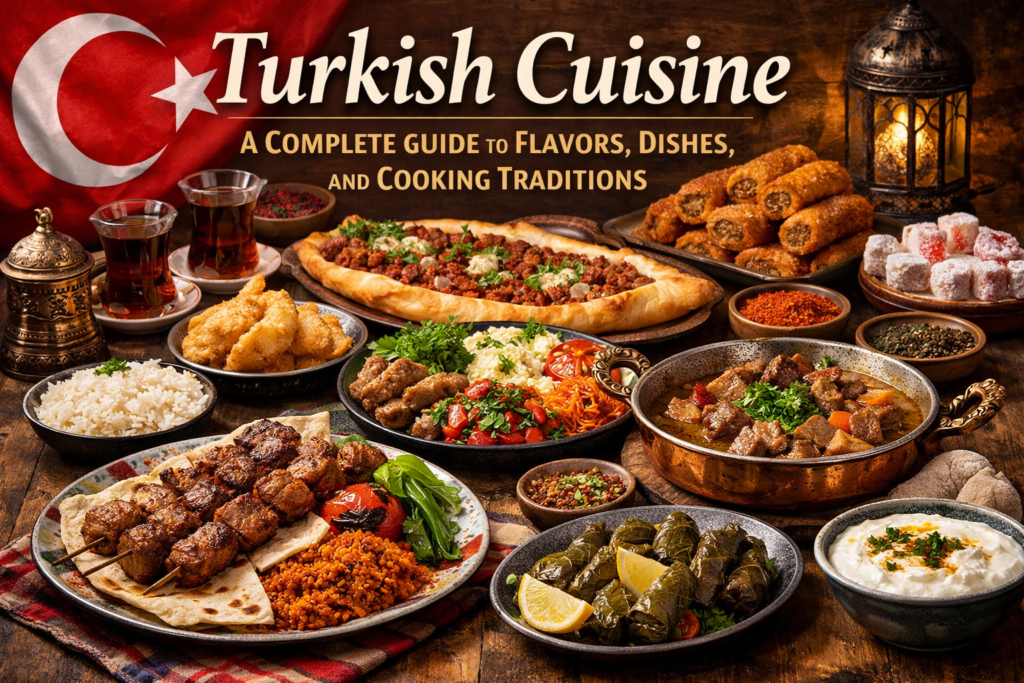
Few culinary traditions in the world can match the depth, diversity, and sheer deliciousness of Turkish cuisine. Sitting at the crossroads of Europe, Asia, and the Middle East, Turkey has spent centuries absorbing and refining culinary influences from every direction — producing a food culture so rich and varied that it is widely considered one of the three great cuisines of the world, alongside French and Chinese cooking.
From the smoky charcoal-grilled meats of Anatolia to the delicate stuffed vegetables of the Aegean coast, from fragrant lentil soups to paper-thin pastries layered with honey and ground nuts — Turkish cuisine is a world unto itself. Whether you’re an experienced home cook looking to expand your repertoire or a curious food lover wanting to understand what makes this cuisine so beloved globally, this guide has everything you need to know.
The History Behind Turkish Cuisine
Understanding Turkish food means understanding Turkish history. The Ottoman Empire, which stretched across three continents for more than six centuries, created palace kitchens that were among the most sophisticated culinary institutions the world had ever seen. At its height, the Topkapi Palace kitchens in Istanbul employed over 1,300 staff cooking for thousands of people daily — experimenting with ingredients, techniques, and spice combinations from across the known world.
This imperial culinary heritage filtered outward into the broader culture and blended with deeply rooted Central Asian nomadic traditions, Byzantine cooking methods, and Arab, Persian, and Balkan influences. The result is a cuisine of extraordinary variety — one where each region of Turkey has its own distinct dishes, ingredients, and cooking identity. According to Britannica, Turkish cuisine is one of the most geographically diverse food cultures in the world, with each of Turkey’s seven regions offering a genuinely distinct culinary experience.
Today, Turkish food is experiencing a powerful global moment. Turkish restaurants are thriving in cities worldwide, Turkish food content dominates social platforms, and ingredients like sumac, pomegranate molasses, and Turkish red pepper paste (biber salçası) are becoming staples in international home kitchens. If you’re drawn to Mediterranean-inspired cooking , Turkish cuisine belongs at the very center of your exploration.
The Building Blocks — Key Ingredients in Turkish Cooking
Before you can cook Turkish food confidently, you need to understand the ingredients that give it its character. Turkish cuisine relies on a smaller set of core ingredients than you might expect, used with great skill and intention.
The essential spices and condiments
Sumac
Deep red, tart citrus flavour — used on grilled meats, salads, and mezze
Cumin
Earthy and warm — essential in köfte, lentil soups, and meat dishes
Red pepper flakes (pul biber)
Mild to medium heat — used on almost everything, especially eggs and dips
Biber salçası
Turkish red pepper paste — the backbone of stews, sauces, and marinades
Dried mint
More prevalent than fresh mint — used in soups, yogurt sauces, and salads
Pomegranate molasses
Sweet, tart, and deep — used in dressings, marinades, and dips
Beyond spices, Turkish cooking relies heavily on high-quality olive oil, particularly in Aegean and Mediterranean regional dishes. Fresh tomatoes and peppers form the base of countless sauces and stews. Yogurt is not just a side dish — it is a cooking ingredient, a sauce base, a marinade, and a condiment used throughout the day. Full-fat plain yogurt (süzme yogurt, the strained variety) is especially prized and appears in dishes from breakfast through dinner.
Grains, legumes, and dairy
Bulgur wheat holds a more central place in Turkish cooking than rice in many regions, particularly in southeastern Turkey where it forms the base of köfte and pilaf. Lentils — both red and green — are staples in soups that are eaten daily across the country. White cheese (beyaz peynir), similar to feta, and kaşar (a firm yellow cheese) appear at nearly every meal. Fresh flatbreads, particularly the pillowy lavash and the sesame-coated simit ring, are fundamental to how Turkish food is eaten and experienced.
Must-Know Traditional Turkish Dishes
Turkish cuisine encompasses hundreds of regional dishes, but a core set of iconic preparations defines the cuisine globally and forms the best starting point for any cook exploring this tradition.
🥙Döner and Dürüm
Seasoned, stacked meat (traditionally lamb or chicken) slow-roasted on a vertical rotisserie and served in flatbread with salad, pickles, and sauces. One of Turkey’s most globally recognized exports — and entirely different made fresh from its fast-food versions abroad.
🍢Köfte
Seasoned ground meat patties or skewers, typically made with lamb or beef, spiced with cumin, onion, and red pepper. Every region has its own köfte style — İnegöl köfte, Izmir köfte, Akçaabat köfte — each with distinct seasoning and shape.
🍆İmam Bayıldı
Whole eggplant stuffed with a slow-cooked mixture of onion, tomato, and garlic in generous olive oil, then braised until completely tender. A masterpiece of Ottoman vegetarian cooking whose name translates loosely to “the imam fainted” — supposedly from how wonderful it smelled.
🥗Cacık
Chilled yogurt with grated or diced cucumber, fresh garlic, dried mint, and olive oil — served as a soup, a dip, or a sauce alongside grilled meats. The Turkish cousin of Greek tzatziki, but lighter, more herb-forward, and often more liquid in consistency.
🍲Mercimek Çorbası (Red Lentil Soup)
Turkey’s most beloved everyday soup — red lentils simmered with onion, carrot, tomato paste, and cumin until silky smooth, then finished with a sizzled butter and red pepper flake drizzle. Simple, deeply nourishing, and made in virtually every Turkish household multiple times a week.
🥧Börek
Flaky, layered pastry made from yufka (thin pastry sheets similar to filo) filled with cheese, spinach, spiced meat, or potato. Baked or pan-fried, börek is eaten at breakfast, as a snack, and as a full meal — one of the most versatile and beloved items in all of Turkish cooking.
Did you know? Turkey is one of the few countries in the world that is fully self-sufficient in food production — its varied geography, from coastal plains to mountain valleys, supports an extraordinary range of ingredients grown domestically year-round.
The Turkish Mezze Tradition
One of the most distinctive and enjoyable aspects of Turkish cuisine is the mezze tradition — a spread of small, flavourful dishes served together at the start of a meal, designed for sharing, lingering, and conversation. The Turkish mezze table is one of the great pleasures of the cuisine, and many of its components are surprisingly straightforward to prepare at home.
A classic Turkish mezze spread might include haydari (thick strained yogurt with garlic and herbs), acılı ezme (spicy tomato and pepper dip), muhammara (roasted red pepper and walnut dip), dolma (stuffed grape leaves or vegetables), patlıcan salatası (smoky roasted eggplant salad), and a plate of white cheese drizzled with olive oil and dried herbs. Each component is simple on its own — but together, they create a table that feels generous, celebratory, and deeply satisfying.
As Serious Eats notes in their guide to Turkish food, the mezze tradition is fundamentally about hospitality — it is how Turkish hosts say “you are welcome here” before a single main course has been served. Learning to put together a mezze spread is one of the most rewarding things a home cook can do with Turkish cuisine.
Regional Variations — Turkish Cuisine Is Not One Thing
One of the most important things to understand about Turkish cuisine is how dramatically it varies by region. Turkey is a large and geographically diverse country, and its food reflects that.
Aegean and Mediterranean coast
The western coastal regions produce some of Turkey’s most celebrated olive oils and rely heavily on fresh vegetables, wild herbs, and seafood. Dishes here tend to be lighter, olive oil-forward, and deeply aromatic with fresh thyme, oregano, and bay leaf. Zeytinyağlılar — dishes cooked entirely in olive oil and served at room temperature — are a hallmark of this region.
Southeastern Anatolia
Cities like Gaziantep (Antep) and Şanlıurfa are the heartland of Turkey’s most intensely flavoured cooking. Gaziantep in particular is considered by many food experts to be one of the great culinary cities of the world — its lahmacun (thin, crisp meat-topped flatbread), katmer (flaky pastry with clotted cream and ground pistachios), and kebab varieties are legendary. The region uses more spice, more heat, and more depth than other parts of Turkey. According to CNN Travel, Gaziantep is one of only a handful of cities globally to hold UNESCO Creative City of Gastronomy status.
The Black Sea coast
Turkey’s northern coast is anchored by corn, anchovies (hamsi), hazelnuts, and a rich dairy tradition. Dishes here are heartier and more rustic — cornbread, anchovy pilafs, and slow-cooked stews with butter and cream define the regional table.
Central Anatolia
The interior heartland is known for its meat-heavy traditions, bread culture, and classic tarhana soup — a fermented dried soup made from yogurt and wheat that is one of the oldest preserved foods in Turkish culinary history.
How to Start Cooking Turkish Food at Home
The good news for home cooks is that Turkish cuisine, despite its complexity and depth, is remarkably accessible to cook. The majority of classic Turkish dishes require no special equipment, use widely available ingredients, and rely on techniques — braising, grilling, roasting, simmering — that most home cooks already know.
Start with the dishes that will give you the biggest return on effort: red lentil soup (mercimek çorbası), a simple köfte with yogurt and flatbread, an imam bayıldı, and a basic haydari dip. These four dishes alone will teach you the fundamental flavour principles of Turkish cooking — and they’re all genuinely delicious, family-friendly meals that fit naturally into a regular weekly rotation.
Build your spice pantry gradually. Start with sumac, pul biber (Turkish red pepper flakes), cumin, and a jar of biber salçası (red pepper paste, available in most international grocery stores or online). These four items will unlock a huge range of Turkish recipes. For tips on keeping your spice collection organized and fresh, see our guide on kitchen organization strategies that make cooking from any world cuisine more efficient.
For deeper recipe guidance, The Turkish Cookbook — a comprehensive encyclopaedia of Turkish regional cooking — is widely considered the definitive English-language resource on this cuisine and is an invaluable reference for any serious home cook wanting to explore the tradition in full.
Frequently Asked Questions
What makes Turkish cuisine unique compared to other Middle Eastern cuisines?
Turkish cuisine blends Central Asian, Ottoman imperial, Mediterranean, and Middle Eastern influences in a way no other cuisine does. It’s distinguished by its heavy use of yogurt as a cooking ingredient, its deep pastry tradition (börek, baklava), its extraordinary regional diversity, and its emphasis on slow-cooked vegetable and legume dishes alongside grilled meats.
Is Turkish food spicy?
Turkish food is flavourful and aromatic but not uniformly spicy. Spice levels vary significantly by region — southeastern dishes (particularly from Gaziantep and Urfa) tend to be hotter, while Aegean and Mediterranean dishes are mild and herb-forward. Most dishes can be adjusted to personal heat preference.
What are the most important ingredients to buy to start cooking Turkish food?
Start with sumac, pul biber (Turkish red pepper flakes), cumin, biber salçası (red pepper paste), full-fat plain yogurt, and good-quality olive oil. These six ingredients will allow you to cook a wide range of authentic Turkish dishes immediately.
What is the most popular Turkish dish worldwide?
Döner kebab is arguably the most globally recognized Turkish dish, present in cities worldwide. However, within Turkey itself, red lentil soup (mercimek çorbası), köfte, and börek are eaten daily by millions and are considered more representative of everyday Turkish home cooking.
Is Turkish cuisine healthy?
Traditional Turkish cuisine is widely regarded as one of the healthiest in the world. It centres on legumes, vegetables, olive oil, yogurt, whole grains, and lean grilled meats — aligning closely with the principles of the Mediterranean diet, which is consistently ranked among the most health-supportive dietary patterns by nutritionists and researchers.
Conclusion
Turkish cuisine is not just a collection of recipes — it is a living, breathing culinary civilization with thousands of years of history, extraordinary regional diversity, and a warmth and generosity of spirit that runs through every dish. Whether you start with a silky red lentil soup, a perfectly spiced köfte, or a mezze spread that takes over your whole table, you are stepping into one of the most rewarding culinary traditions on the planet. Start simple, build your pantry gradually, and let the food speak for itself. Turkish cuisine will not disappoint.
Leave a Reply